
Human movement feels incredibly effortless most days. You walk down the street, talk to your friends, and breathe deeply without thinking. However, a highly complex biological system controls every single physical action you take. Your brain acts as the central command center for your entire body.
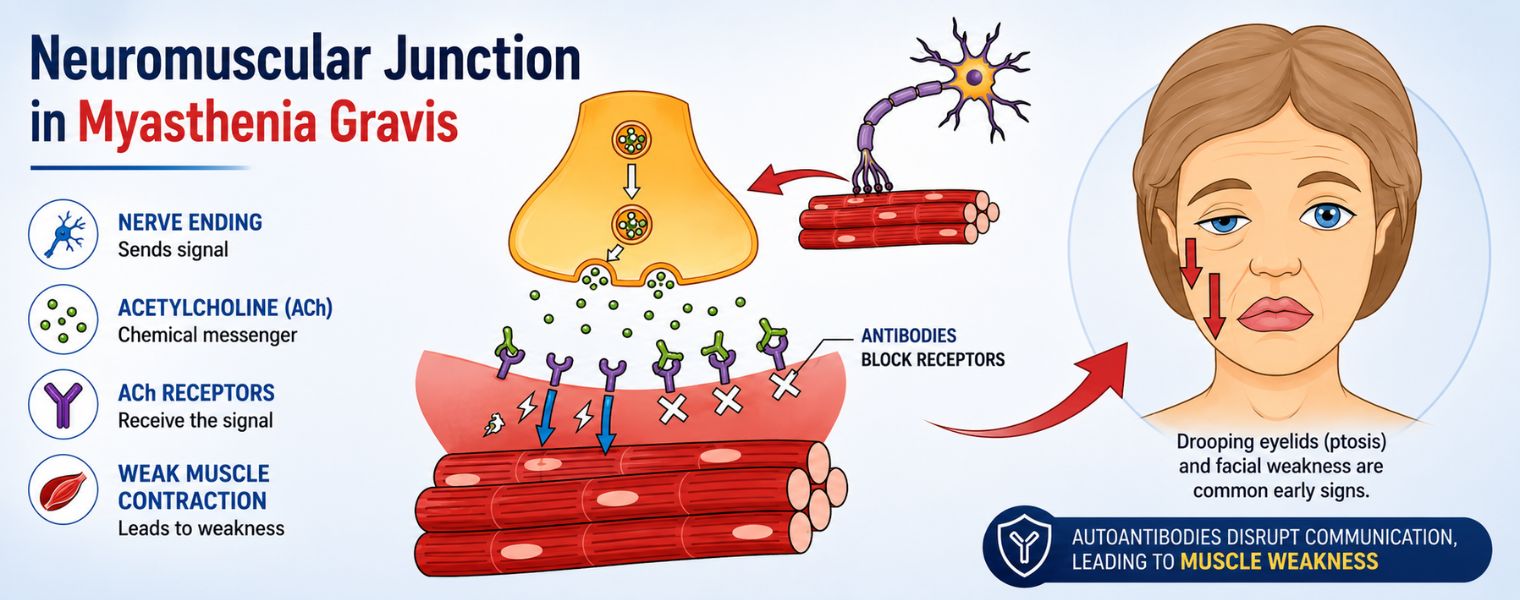
It sends rapid, microscopic electrical signals down your spinal cord. These vital signals travel through your intricate nerve network to reach your voluntary muscles. They finally meet at a microscopic gap between the nerve ending and the muscle fiber. Medical professionals call this vital connection the neuromuscular junction. In patients with Myasthenia Gravis, this elegant communication system completely breaks down. We want to help you deeply understand exactly why this specific failure happens.
Your nervous system works like a massive, high-speed electrical grid. A conscious thought initiates an electrical impulse in your brain. This impulse races down the specific nerve pathway responsible for the intended movement. The signal travels at incredible speeds to ensure your muscles react instantly.
Eventually, the electrical signal reaches the very end of the nerve fiber. The nerve ending sits extremely close to the muscle fiber, but it never actually touches it. A tiny, fluid-filled space permanently separates the two structures. The electrical signal cannot physically jump across this microscopic gap alone. It requires a chemical bridge to complete the long journey.
Healthy nerves must cross this fluid-filled gap to create physical movement. They release a highly specific chemical messenger to bridge the distance. Scientists call this vital chemical messenger acetylcholine.
The nerve ending stores millions of acetylcholine molecules inside tiny biological bubbles. When the electrical signal arrives, these bubbles burst open immediately. They dump the chemical messenger directly into the microscopic gap. The acetylcholine travels swiftly across the fluid-filled space toward the waiting muscle.
The surface of your muscle fiber contains thousands of specialized biological locks. Doctors call these locks acetylcholine receptors. The chemical messenger acts as the perfect physical key for these specific locks.
The acetylcholine binds directly to the waiting receptors. This rapid binding action unlocks the muscle fiber instantly. The chemical reaction forces the entire muscle to contract and create physical force. You move your arm, blink your eyes, or take a deep breath. A healthy neuromuscular junction easily processes millions of these chemical signals every single minute.
Myasthenia Gravis drastically alters this normal biological process. Your immune system makes a severe, unprovoked biological mistake. Your immune system normally uses healthy antibodies to fight dangerous viruses and bacteria.
In this specific autoimmune disease, the system becomes confused. It mistakenly produces harmful proteins called autoantibodies. These rogue autoantibodies actively attack your own healthy body tissues instead of fighting real infections. They specifically target the vital neuromuscular junction.
These rogue autoantibodies flood the microscopic gap between your nerves and muscles. They physically attach themselves to the empty acetylcholine receptors on your muscle fibers. They act like broken keys jammed violently into the biological locks.
Your nerves still release the acetylcholine messenger perfectly fine. The chemical travels across the gap just like normal. However, the messenger cannot find any open receptors. The rogue autoantibodies block the chemical from binding to the muscle. Your muscles simply cannot receive the vital command to move. This total communication failure directly causes your severe daily physical symptoms.
The autoantibodies do more than just block the vital receptors. They also trigger a destructive inflammatory response at the junction. The immune system calls in specialized destructive proteins to the area.
These proteins physically damage the delicate surface of the muscle fiber. They permanently destroy many of the acetylcholine receptors. The muscle surface becomes flat and heavily scarred over time. This permanent damage severely reduces the muscle's ability to receive any future chemical signals.
Medical researchers have identified several different antibodies that cause this specific disease. A proper medical diagnosis requires identifying your specific antibody type.
Most patients produce antibodies against the acetylcholine receptor itself. Doctors call these AChR antibodies. This remains the most common form of the disease globally. A simple blood test can usually detect these harmful proteins floating in your veins.
Some patients test completely negative for standard AChR antibodies. However, they still experience severe, undeniable muscle weakness. Their bodies produce antibodies against a different vital protein called Muscle-Specific Kinase (MuSK).
This vital protein normally helps organize and maintain the acetylcholine receptors on the muscle surface. When autoantibodies destroy MuSK, the acetylcholine receptors scatter randomly. They lose their normal physiological function completely. The resulting muscle weakness severely impacts the patient's daily life.
Medical science continues to discover new autoantibodies related to this disease. Researchers recently identified antibodies against Lipoprotein-Related Protein 4 (LRP4).
This specific protein also helps build and maintain the healthy neuromuscular junction. When autoantibodies attack LRP4, the communication system fails just like in other forms of the disease. Identifying these rare antibodies helps neurologists tailor specific, effective treatment plans for patients.
This microscopic biological battle creates a very specific type of physical fatigue. You experience severe, painless muscle weakness rather than general tiredness. This specific weakness predictably worsens as you repeatedly use the affected muscle.
Your muscles literally run out of available receptors to process the chemical signals. The more you move, the weaker the muscle becomes. The weakness always improves significantly after you physically rest the muscle for a while.
Most patients experience a distinct daily pattern of muscle weakness. You usually wake up with rested, fully stocked receptors in the morning. You feel relatively strong and capable of tackling your daily tasks.
Your available receptors quickly burn out as you move around during the day. Your limbs start feeling incredibly heavy and unresponsive by the early afternoon. You severely struggle to chew, speak, or walk by dinner time. You require immediate physical rest to recover your lost strength.
The disease frequently targets the specific muscles controlling your face and throat. Doctors refer to these as bulbar muscles. Communication failure here causes incredibly frustrating daily challenges.
You may experience slurred speech after talking for several minutes. You might struggle to chew tough meats like steak or pork chops. Many patients experience dangerous choking episodes while trying to swallow thin liquids like water.
Neurologists use specialized medical tests to observe this communication failure firsthand. They cannot diagnose the condition based on physical symptoms alone. They frequently perform a nerve conduction study in their clinic.
The doctor repeatedly sends a small electrical shock through your specific nerve. They watch your connected muscle response on a digital monitor. In healthy individuals, the muscle reacts strongly every single time the doctor shocks the nerve.
In MG patients, the muscle response rapidly weakens with each successive electrical shock. The damaged receptors simply cannot keep up with the continuous electrical demand. This specific test strongly confirms the underlying neuromuscular communication failure.
Sometimes, standard nerve conduction studies do not show a clear communication failure. The neurologist will then perform a highly advanced Single-Fiber EMG test.
The doctor inserts a microscopic needle directly into a single muscle fiber. They measure the precise electrical activity of that individual fiber during movement. This incredibly sensitive test can detect even the tiniest communication failures at the neuromuscular junction. It remains the gold standard for diagnosing complex cases.
Doctors use their deep biological knowledge to design highly effective medical treatments. They cannot cure the autoimmune disease, but they can drastically improve the communication pathway.
They frequently prescribe a class of drugs called acetylcholinesterase inhibitors. Pyridostigmine remains the most common and effective first-line drug worldwide. Almost every patient takes this medication to manage their daily physical symptoms.
Your body naturally produces an enzyme that cleans up leftover acetylcholine in the microscopic gap. Pyridostigmine actively blocks this specific cleanup enzyme.
This daily medication prevents the normal breakdown of acetylcholine at the junction. It physically floods the microscopic gap with extra chemical messengers. These extra messengers easily find the surviving, unblocked receptors on your muscles. This medication temporarily restores your muscle strength and dramatically improves your physical movement.
Pyridostigmine only treats the immediate symptoms of the disease. It does not stop the immune system from producing rogue autoantibodies. Your doctor must eventually prescribe medications to calm your overactive immune system.
They frequently prescribe broad immunosuppressants like prednisone, azathioprine, or mycophenolate mofetil. These powerful drugs slowly train your immune system to stop attacking your healthy muscles. They protect your surviving receptors from further permanent biological damage.
You must fiercely protect your surviving receptors from further biological damage. You must strictly avoid all contraindicated medications prescribed by other doctors.
Certain common antibiotics, beta-blockers, and statins slightly disrupt the neuromuscular junction. Healthy people never notice this minor biological disruption. However, MG patients lack spare, functioning receptors to handle the extra stress. Taking these routine drugs can instantly paralyze your remaining functional muscles.
Understanding the biology of your disease helps you manage it much more effectively. You must actively conserve your available acetylcholine receptors throughout the day.
Schedule your most physically demanding tasks for the early morning when your receptors remain fully stocked. Take frequent, short rest breaks to allow your neuromuscular junction to recover chemical messengers. Always prioritize your physical rest and listen to your body's clear warning signs.
© 2026 Myasthenia Gravis. All Rights Reserved