
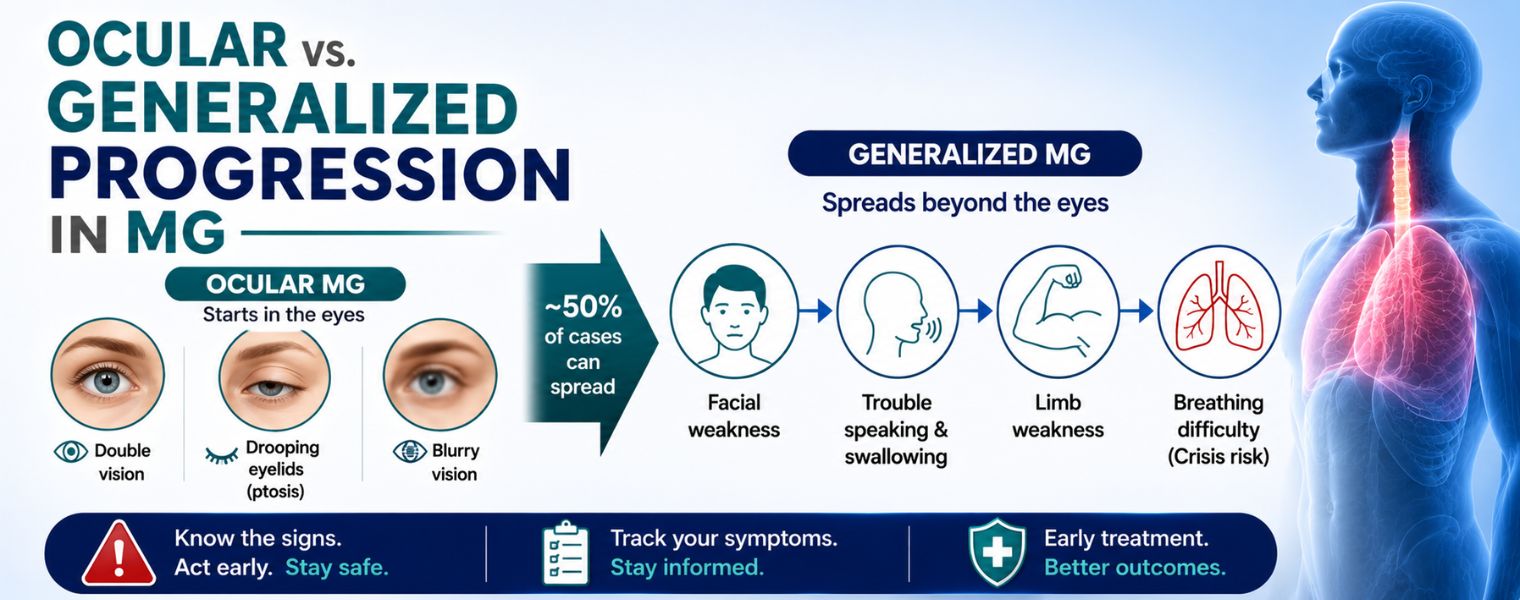
Myasthenia Gravis rarely strikes your entire body all at once with massive, paralyzing weakness. The autoimmune disease usually begins with very small, incredibly subtle changes in your face.
You might notice a slight drooping eyelid when you look closely in the mirror. You might suddenly struggle to read a book because the words overlap slightly. The condition often stays localized strictly to your eyes initially, but it can aggressively spread. We track exactly how this physical progression happens.
Six tiny extraocular muscles actively control the rapid, precise movements of your eyes and eyelids. These delicate muscles remain incredibly sensitive to harmful immune system attacks.
Unlike your leg muscles, these eye muscles move constantly throughout your entire waking day. Because they move constantly, they exhaust their chemical messengers very quickly. This biological reality makes them the primary initial target for the disease. Almost 85% of all patients experience annoying eye problems as their very first physical symptom.
When symptoms exclusively affect your eyes, doctors diagnose you with ocular myasthenia. The rest of your body retains perfectly normal physical strength and stamina.
You can still easily climb stairs, chew tough steak, and breathe deeply without any trouble. The rogue autoantibodies only actively attack the specific neuromuscular junctions surrounding your eyes. Doctors closely monitor ocular patients because the disease trajectory remains highly unpredictable.
The most common ocular symptom involves severe weakness in your eyelid muscles. Doctors formally refer to this specific drooping condition as ptosis.
One or both of your eyelids droop heavily over your actual eyeball. The drooping frequently covers your pupil and severely obstructs your field of vision. The eyelid predictably feels heaviest in the late evening after a long day of blinking.
The disease also attacks the muscles that keep your eyes perfectly aligned with each other. When these muscles weaken, your eyes stop working together in perfect unison.
Doctors refer to this specific alignment failure as diplopia, or severe double vision. You look at a single coffee cup but distinctly see two overlapping cups. The double vision usually disappears instantly if you physically cover one eye with your hand.
Ocular symptoms cause extreme daily frustration and severe social anxiety for patients. Unpredictable double vision completely prevents you from safely driving a car to work. Heavy, drooping eyelids make you look constantly exhausted or intoxicated to your concerned peers.
You must rest your eyes frequently throughout the day to regain baseline function. Doctors often prescribe acetylcholinesterase inhibitors to temporarily lift the heavy eyelids back up. Some patients wear specialized prism glasses or eye patches to stop the nauseating double vision.
The autoimmune disease does not always stay confined strictly to your eyes forever. In about 50% of cases, the weakness aggressively spreads down the rest of the body.
Doctors formally call this transition generalized Myasthenia Gravis. This dangerous spread typically happens within the first two years of your initial diagnosis. If your symptoms remain strictly ocular for three full years, they rarely generalize later in life.
When the disease generalizes, it typically moves downward in a very predictable pattern. It usually attacks your lower facial muscles first.
You might lose the physical ability to smile fully or close your lips tightly. Your friends might notice your facial expressions look unusually flat or completely emotionless. You might also struggle to hold your heavy head up as your neck muscles severely weaken.
The disease eventually targets the vital muscles controlling your throat and jaw. Doctors refer to these crucial structures as your bulbar muscles.
Bulbar weakness introduces incredibly frustrating and dangerous daily physical challenges. You experience slurred speech after talking on the phone for just several minutes. You severely struggle to chew tough meats and frequently choke on thin liquids like water.
As the disease progresses further, it completely drains the strength from your limbs. The physical exhaustion quickly becomes incredibly debilitating and hard to manage alone.
You may severely struggle to hold your arms up while washing or brushing your hair. You might find it physically impossible to rise from a low chair or climb stairs. Your legs feel like heavy lead weights by the late afternoon.
The most terrifying progression involves the vital muscles controlling your breathing. The disease severely weakens your large diaphragm and your intercostal chest muscles.
You experience sudden, intense shortness of breath while simply resting quietly in bed. This specific progression marks a severe myasthenic crisis and requires immediate emergency hospital care. Doctors aggressively try to halt the disease progression before it reaches your chest.
You must actively track your physical symptoms every single day without fail. Keep a detailed, written symptom journal to share with your personal neurologist.
Note exactly when your arms feel heavy or your swallowing feels slightly difficult. Record whether the weakness improves after you rest quietly for thirty minutes. This detailed data helps your doctor determine if your ocular disease has generalized.
Your neurologist heavily adjusts your medical treatments as your disease physically progresses. Foundational medications like pyridostigmine often handle mild ocular symptoms perfectly fine.
However, generalized symptoms almost always require powerful daily immunosuppressants or corticosteroids to manage effectively. If the disease resists standard pills, your doctor will prescribe advanced targeted biologic infusions.
Early medical intervention remains absolutely crucial for all newly diagnosed ocular patients. Some clinical studies suggest that starting immunosuppressants early might delay or prevent full disease generalization.
You must attend all scheduled neurology appointments, even if your current symptoms feel mild. Never ignore new muscle weakness, and always report spreading symptoms to your doctor immediately.
© 2026 Myasthenia Gravis. All Rights Reserved