
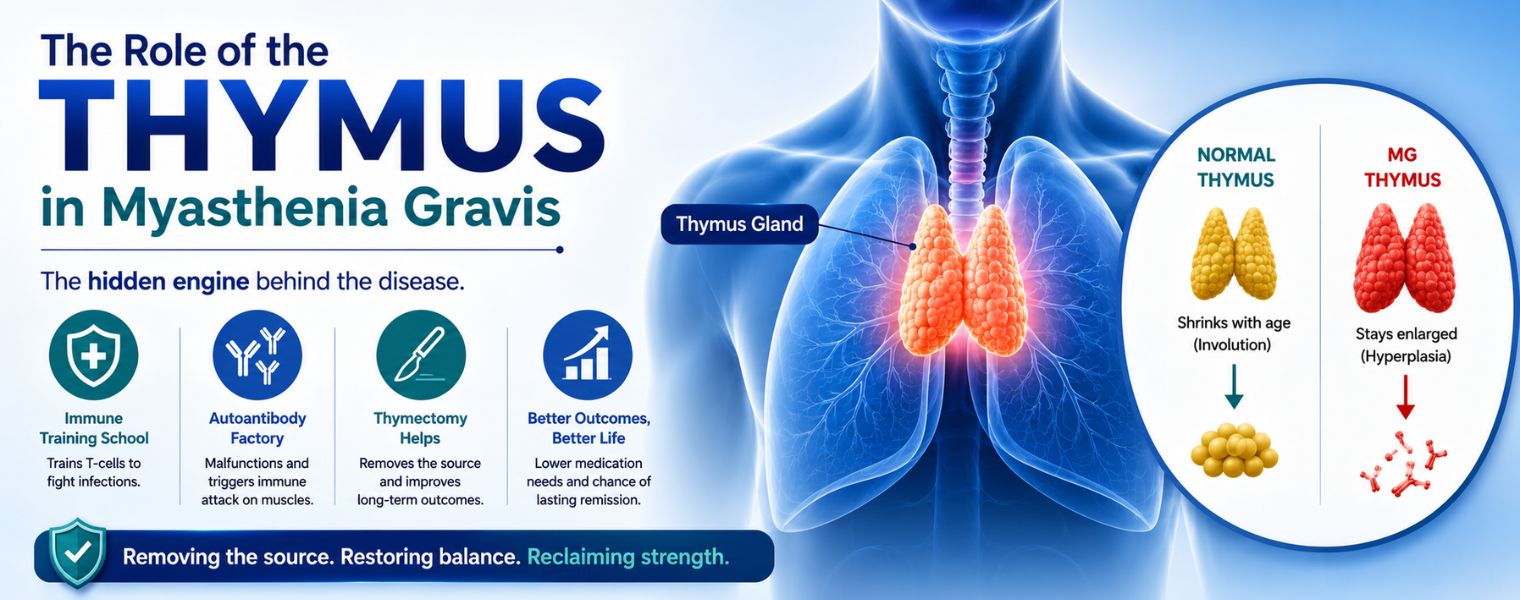
The human immune system relies on many different organs to function properly. One specific organ hides quietly behind your breastbone in your upper chest. Doctors call it the thymus gland.
This small, butterfly-shaped organ plays a massive, destructive role in causing Myasthenia Gravis. Many patients require major chest surgery to remove it entirely from their body. We want to explicitly explain exactly why this specific gland causes so much trouble.
The thymus serves as a critical training school for your developing immune system. It teaches your white blood cells how to fight off severe external infections.
This vital organ stays very large and highly active during your childhood years. It pumps out millions of trained immune cells to protect your growing body. Medical scientists call these specialized immune cells T-cells.
A healthy adult immune system no longer requires this specialized training school to function. Therefore, the thymus gland normally shrinks as you enter puberty.
The active pink tissue slowly turns to useless yellow fat as you become an adult. Doctors call this normal biological shrinking process involution. In a healthy adult, the thymus gland virtually disappears and stops producing new immune cells.
In patients with Myasthenia Gravis, the thymus gland completely malfunctions. It stubbornly refuses to shrink and turn to fat during adulthood.
Instead, it remains abnormally large and overly active inside your chest cavity. Doctors call this specific medical condition thymic hyperplasia. Over 70% of all MG patients possess an abnormally enlarged thymus gland.
This malfunctioning gland gives your white blood cells the completely wrong biological instructions. It incorrectly teaches your T-cells to attack your own healthy neuromuscular junction.
The thymus essentially becomes a dangerous factory producing rogue autoantibodies. These rogue proteins flood your bloodstream and block the acetylcholine receptors on your muscles. This direct biological sabotage creates your severe daily physical fatigue.
Approximately 15% of all MG patients develop a distinct solid tumor on their thymus gland. Medical professionals refer to these specific tumors as thymomas.
Most thymomas remain completely benign. They typically do not contain spreading, aggressive cancer cells. However, they aggressively drive the harmful autoimmune response in your body. They force the immune system to produce massive amounts of destructive autoantibodies.
Your neurologist will always check your thymus gland immediately after diagnosing you with MG. They cannot physically feel the gland because it sits behind your hard breastbone.
Instead, they order a high-resolution CT scan or MRI of your chest. The radiologist carefully measures the exact size and shape of your thymus gland. They look specifically for hidden thymomas or abnormal tissue enlargement.
Neurologists mandate the immediate surgical removal of any discovered thymoma to protect your life. Even benign tumors can eventually press against your vital heart or lungs.
Furthermore, removing the tumor removes the massive autoantibody factory driving your disease. Doctors also frequently recommend surgery for patients with an enlarged thymus, even without a tumor. They strictly refer to this surgical procedure as a thymectomy.
Surgeons have performed thymectomies to treat Myasthenia Gravis for many decades. Historically, the procedure required an incredibly invasive surgical approach.
Surgeons used a surgical saw to split the entire breastbone wide open. They called this highly traumatic procedure a full median sternotomy. Patients endured immense physical pain and required months of difficult recovery at home.
Today, highly trained thoracic surgeons use minimally invasive, robotic-assisted surgical techniques. They completely avoid cutting your breastbone open.
The surgeon makes three tiny incisions on the side of your chest. They insert small robotic camera arms between your ribs. The surgeon controls these precise robotic arms from a digital console in the operating room. They carefully extract the rogue tissue safely and efficiently.
A robotic thymectomy offers a much faster, significantly easier recovery for patients. You usually spend only one or two nights recovering in the hospital.
You will experience moderate chest soreness for a few weeks after returning home. Your doctor will strictly limit your physical lifting during this crucial healing phase. However, most patients comfortably return to their normal daily activities within a single month.
A thymectomy rarely provides an immediate, overnight cure for your severe symptoms. The rogue autoantibodies already circulating in your blood take months to naturally degrade.
Furthermore, the immune system takes significant time to cool down and forget its bad training. You will absolutely wake up from surgery still having Myasthenia Gravis. You must continue taking your prescribed daily medications during your surgical recovery.
Clinical medical studies definitively prove the massive long-term benefits of this procedure. Many patients experience drastically reduced muscle weakness over the following years.
A landmark global study proved that thymectomy patients achieve far better clinical outcomes than patients taking pills alone. They frequently require much lower doses of dangerous daily corticosteroids to maintain their overall health. Some lucky patients eventually achieve complete, medication-free clinical remission.
You must discuss the potential risks and benefits of surgery extensively with your neurologist. Surgery carries inherent risks, including bleeding or infection.
However, the potential for long-term disease remission makes it a highly attractive option for eligible patients. The surgery works best for patients under the age of 65 who have AChR-positive antibodies.
© 2026 Myasthenia Gravis. All Rights Reserved