
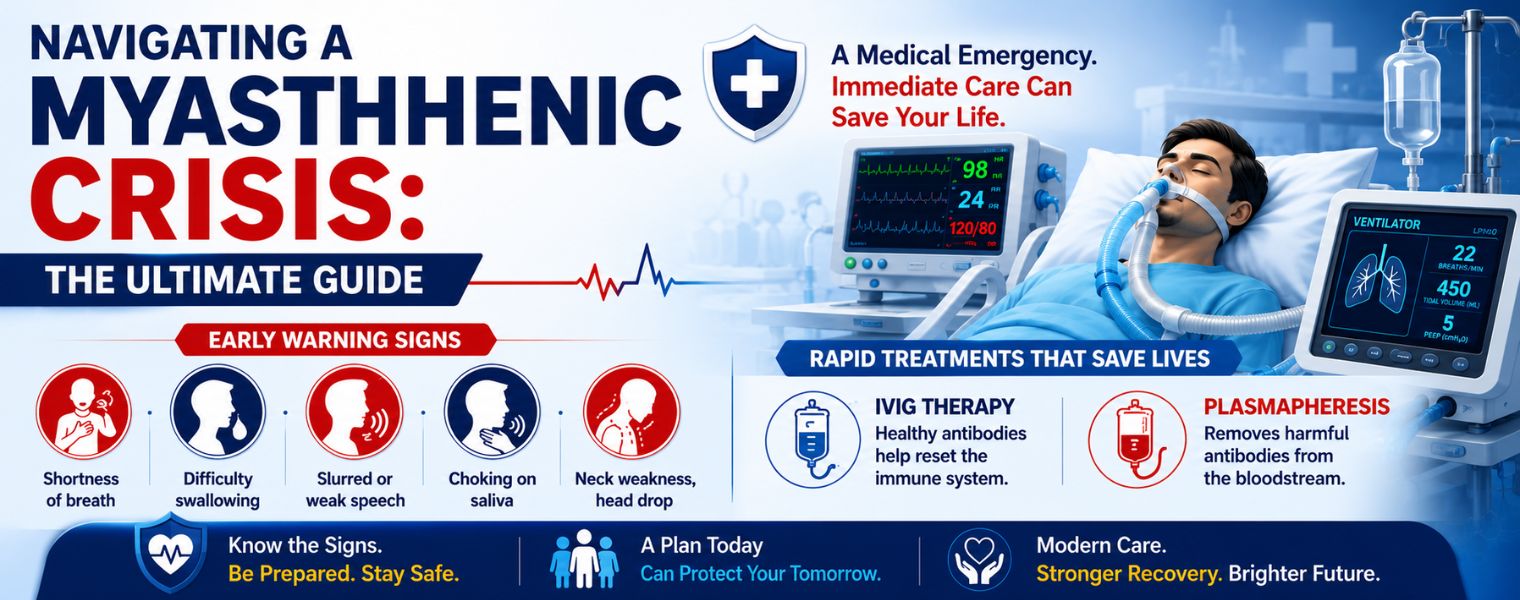
Most patients manage their Myasthenia Gravis symptoms smoothly at home using daily medications. However, the disease occasionally triggers a severe, life-threatening medical emergency. Doctors call this terrifying event a myasthenic crisis.
Your breathing and swallowing muscles weaken to the point of total physical failure. You must seek immediate emergency medical care during a crisis. We want to outline the critical warning signs you must memorize today. Understanding these protocols protects your life and gives your family actionable steps.
A myasthenic crisis represents the most dangerous possible complication of this autoimmune disease. It occurs when your vital diaphragm and chest muscles become completely exhausted.
You physically lose the ability to pull enough air into your lungs. You also lose the ability to swallow your own saliva or daily pills. This creates an immediate, severe choking hazard. A crisis always requires rapid medical intervention in a hospital intensive care unit.
Breathing feels completely automatic to healthy individuals. However, breathing requires immense physical work from several large muscle groups. Your diaphragm sits below your lungs and pulls downward to create a vacuum.
Your intercostal muscles sit between your ribs and expand your chest outward. These vital muscles constantly require acetylcholine chemical messengers to function. During a crisis, rogue autoantibodies completely block these chemical messengers. Your chest muscles simply stop contracting, and your lungs cannot inflate.
You must act quickly before your breathing stops completely. Always watch your body for these severe, unmistakable red flags:
A crisis rarely happens without a specific, identifiable biological trigger. You must actively avoid these common health hazards whenever possible.
Severe respiratory infections frequently push weak muscles over the edge. Extreme emotional trauma and severe sleep deprivation often trigger sudden muscle failure. Furthermore, taking restricted medications, like certain antibiotics, can instantly paralyze your functional muscles. Suddenly stopping your prescribed immunosuppressants also triggers massive symptom flare-ups.
Bacterial pneumonia and viral bronchitis remain the most common triggers for a crisis. An infection forces your immune system into overdrive.
Your immune system rapidly produces millions of new antibodies to fight the virus. Unfortunately, it also accidentally produces a massive surge of harmful autoantibodies. These extra autoantibodies quickly flood your neuromuscular junction and paralyze your breathing muscles. You must treat all chest infections aggressively with your doctor.
Paramedics will rush you directly to the hospital emergency department. Emergency room doctors always prioritize your breathing above all else.
They will immediately measure the oxygen levels in your blood. They also measure your vital lung capacity using a spirometer device. If your lung capacity drops too low, they must intervene immediately to save your life.
Doctors frequently insert a plastic breathing tube directly down your throat. They connect this vital tube to a mechanical ventilator machine.
This machine physically breathes for you while your chest muscles safely rest. The machine pushes oxygen-rich air directly into your lungs. It completely removes the physical burden from your exhausted diaphragm. They will also provide all necessary nutrition and hydration through a specialized feeding tube.
Doctors must quickly remove the harmful autoantibodies from your circulating blood. They cannot wait weeks for daily immunosuppressant pills to work. They rely on two highly effective, rapid clinical treatments in the hospital.
Both treatments actively clean your blood and reset your immune system. Doctors choose the specific treatment based on your medical history and available hospital equipment.
Many hospitals utilize Intravenous Immunoglobulin (IVIg) therapy during a crisis. Nurses infuse healthy, donated antibodies directly into your veins over several days.
These healthy donor antibodies temporarily overwhelm and reset your misfiring immune system. They stop your body from producing more harmful autoantibodies. This treatment usually improves your muscle strength within a week.
Doctors also utilize an aggressive procedure called plasmapheresis, or plasma exchange. A specialized medical machine physically filters the rogue autoantibodies completely out of your bloodstream.
The machine separates your liquid plasma from your healthy blood cells. It discards the toxic plasma containing the autoantibodies. The machine then returns your cleaned blood cells with a safe replacement fluid. This aggressive procedure rapidly restores your muscle strength.
A myasthenic crisis feels incredibly traumatic for patients and their terrified families. However, modern medical protocols save almost all patients who experience one today.
You will typically spend one to two weeks recovering in the hospital ICU. Doctors will slowly wean you off the mechanical ventilator as your chest strength returns. They closely monitor your lung capacity every single day.
Your physical journey does not end when you leave the intensive care unit. Your muscles will feel incredibly weak from prolonged bed rest.
Doctors will assign physical therapists to help you rebuild your basic strength. Speech therapists will help you safely practice swallowing solid foods again. You must take your recovery very slowly and prioritize physical rest.
Your neurologist will heavily adjust your daily medications before you leave the hospital. A crisis clearly indicates that your previous treatment plan failed.
They will likely increase your daily immunosuppressant dosage. They might prescribe a new targeted biologic therapy to prevent future emergencies. You must follow this new treatment schedule perfectly at home.
Surviving a respiratory crisis leaves a lasting psychological mark on many patients. You might experience severe anxiety about breathing or sleeping.
Many patients develop medical trauma or post-traumatic stress disorder (PTSD). You should actively seek support from a licensed medical therapist. Discussing your fears openly helps you process the traumatic event safely.
Every MG patient needs a strict emergency plan taped to their refrigerator. This plan guides your family when you cannot speak for yourself.
List your primary neurologist's emergency contact numbers clearly. Print a comprehensive list of all your current daily medications. Include our specific list of contraindicated drugs to hand directly to emergency room doctors.
© 2026 Myasthenia Gravis. All Rights Reserved